

 LinkedIn
I spent years buying bid tools that promised management and delivered PDFs. My test for AEO software is the same: does it change anything, or does it just tell me what needs changing?

What tools actually help a business get featured in Google AI Overviews, not just monitored?
The dashboard does not get you cited. The work happens on your site: a page rewritten so it can be retrieved, structured so a model can quote it cleanly, and backed by enough outside proof to be credible. Software can show where a brand stands without rewriting content, building schema, or landing PR. Someone still has to do those things. If you buy a tracker and expect citations, you bought the thermometer and skipped the furnace.
I used to tell clients a top-three ranking would take care of AI answers. I was wrong. A Surfer analysis of 36M AI Overviews found that cited pages cover 31% more facts on average, and 62% more at the median. CXL found that 55% of citations come from the first 30% of page content. Only about 17% of cited domains also rank in the organic top 10. Your rank tracker can look fine while AI answers ignore you.
That does not mean stuffing facts into the opening paragraph and calling it a day. It means answering the buyer’s actual question early, then making the supporting detail easy to find. A tool that spots the missing answer is useful. A tool that turns that finding into an edit, publishes it, and checks the prompt again does a different job.
And a citation is not the same as a recommendation. In one dataset, AI Overviews recommended a competitor 69% of the time even when citing the brand’s page. An icon count will not tell you that the answer used your page to help someone choose somebody else. Ask the vendor to show the answer text and recommendation for the same prompts, then show what it changed on the site.
How can my business measure brand visibility across ChatGPT, Gemini and Google AI Overviews?
You can measure it, but first find out what the number measures. Every visibility score depends on three settings: the prompts, the engines, and how often the prompts run. Change one and the score can move even if nothing on your site has changed. Vendors use different prompt sets, engine weighting, run frequency, and collection methods. A score is a view through those choices, not a universal grade.
Fix the prompt set, engines, and location; then follow your trend inside one tool. Vendor A at 72 and Vendor B at 41 do not give you a useful comparison. The better question is whether the same buyer questions produce different answers over time, and whether those answers mention, cite, or recommend you. Keep those outcomes separate. They tell you different things.
The plans make the fine print unavoidable. Otterly’s $29 Lite plan gets 15 prompts daily; Peec’s $80 Starter gets 50 prompts across three models; Scrunch’s $250 Core gets 125 prompts; Profound’s $99 Starter is ChatGPT-only. Headline prompt counts are not interchangeable. Engine access is another trap: four of six trackers advertise engines their cheapest plans do not include. Ahrefs Brand Radar lists one platform at $199 and all of them at $699; Otterly’s $29 plan lists four but charges extra for Claude, Gemini, and AI Mode.
Do not buy a reassuring number and discover later that it excluded the place your buyers ask questions. Ask: on this exact plan, how many prompts run, on which engines, in which location, and how often? Then ask to see the answer text behind the score.
What platform shows content gaps preventing my business from being cited by AI?
A gap is not merely a keyword you do not rank for. It is a buyer question where a competitor gets cited and you do not. That prompt-level definition gives you somewhere to work. Broad topic coverage does not earn participation points: an AI answer may choose only two or three sources for a specific prompt, and the citation pool can reshuffle in weeks.
Almost every platform can list gaps. The dividing line is whether anyone fills them. I have watched owners stare at a list of missing prompts with no owner assigned to the work. The report ends just as the job begins. The handoff from monitoring to drafted, publishable content is where many AEO efforts stall.
A usable gap report should point to a question, the answer currently being cited, and the page that could answer it better. Then someone has to make the page narrow enough to address that question, put the answer where it can be found, keep the supporting detail current, and check that exact prompt again. Otherwise, you cannot tell whether the proposed fix shipped, let alone whether the answer changed.
There is a diagnostic step before writing, too. A missing page, an existing page with a buried answer, and a page an AI crawler cannot fetch are not the same assignment. If the report treats them all as “create more content,” it is saving itself work, not you. For that distinction, read how to diagnose four kinds of gaps before writing more content. Ask the vendor to show one gap it found, the page it changed, and the answer before and after. A list of opportunities is not a list of completed work.
Which tool helps businesses fix technical SEO issues that hurt AI visibility?
Start with the gate, not the grade. Cloudflare Radar data shows access-denied responses to AI bots rose from 5.98% to 13.47% year over year in Q3 2026, with GPTBot blocked 1.6 times for every allow. A robots.txt permission does not settle the question if a firewall or CDN returns a 403. A tracker can say the bot is allowed while the page remains inaccessible to it. Check whether the crawler can fetch the page before paying to improve its readiness score.
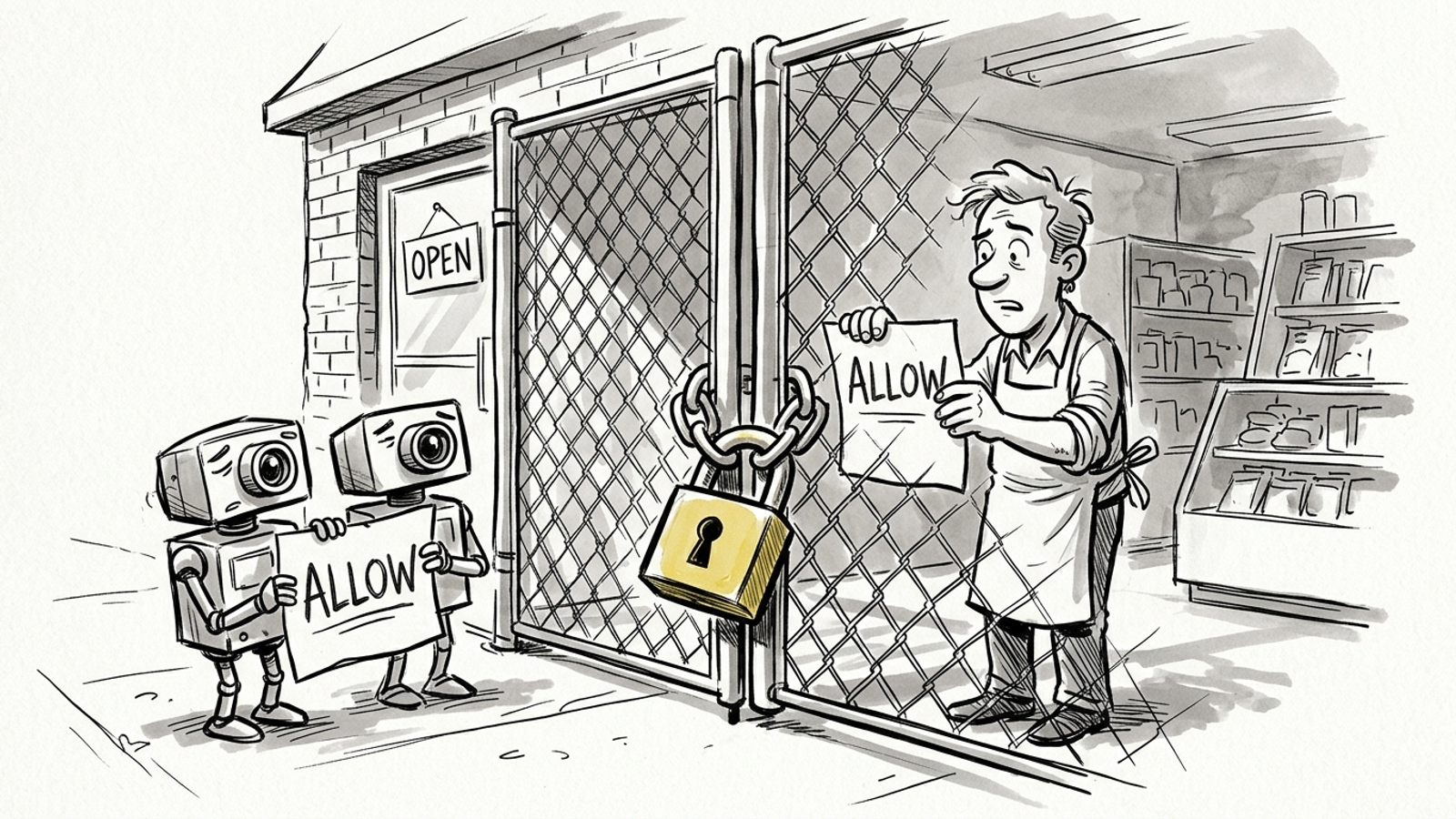
Past the gate, the blockers are unglamorous: JS-locked content, a missing sitemap, product and pricing data that disagree, missing FAQPage or Article schema, and undated pages. A finding that reads Missing FAQPage Schema, critical gives someone a task to investigate and assign. A letter grade does not. Neither does a blended “AI readiness” score that hides the URL and the reason it failed.
That is where the word fix matters. A scanner may identify a problem without having access to your site or anyone assigned to make the change. Your developer may need to handle the firewall or templates; a content owner may need to correct conflicting page copy. I keep this step-by-step playbook for crawler access, rendering, and structured data close for exactly that reason. Ask who touches the site—your team, your developer, or theirs—and when the fix will be checked.
Is done-for-you worth more than a cheaper tracker?
Say you pay $29 a month for a tracker. It hands you 22 tasks, including six page rewrites, schema in three places, a sitemap fix, and two outside mentions. Who does them? If the answer is you, on nights and weekends, or a developer you have to brief and chase, the subscription price is not the cost of getting the work done. It may also buy you about 15 hours of unpaid work a month.
Teams often end up paying for a platform year-round and project help for structural fixes because the software shows where the brand stands, while rewrites and technical work still need execution. I have seen the choices laid out in DIY checks versus visibility trackers versus done-for-you AEO. It matches what I learned in PPC: the tool fee is often the smallest line item. Your time is the invoice.

That does not mean everyone needs done-for-you. If you have one location, one service, and you already publish weekly, a tracker plus two focused hours a week can move you. You can read the gaps, make the edits, and check the prompts yourself. In that setup, paying someone else to own every step may add a handoff you do not need.
If you have 40 service pages, no developer time, and nobody who wants to rewrite answers for ChatGPT and Gemini every month, the cheaper plan can be the expensive one. It tells you exactly how far behind you are, every month, without clearing the queue. Ask what gets published or fixed without you lifting it, and what comes back as homework. groas is built for the second group: teams that want content shipped, technical fixes applied, and the same prompts re-checked without managing dashboards. Its SEO and AI search sprint puts the emphasis on visibility movement, not a login.
What will be different in 30 days, and how do I check it without your dashboard?
That is the monitor-versus-execute test in one question. A tracker answers with charts and logins. Someone doing the work can name what will ship, who will ship it, and how you will check it: pages rewritten for specific prompts, schema added to identified templates, a firewall rule changed, then the same prompts run again on the same engines. In PPC, I learned to ask for the change log before the case study. Anyone can show a CPA drop and claim credit. The log shows whether they touched anything that could have caused it.
So use the question before you sign. Say you are paying $2,000 a month for the service, or spending $20k a month on ads that depend on the same site. Ask what ships in the first 30 days and where you can see proof outside the vendor’s score. If the answer is a task list for you, you did not buy execution. You bought homework at execution prices.
In PPC, my change log had three columns: date, what moved, and why. AEO needs that discipline. A usable entry names the URL, the edit, the prompt it was meant to address, and when that prompt was re-checked. It lets you inspect the page yourself and read the answer, rather than accepting a green arrow on a dashboard. Ask for a redacted example of that kind of log. If the vendor can show only charts, keep asking what changed.
The log also keeps blended scores from doing too much talking. ChatGPT citations can rise while Gemini citations fall; an average can hide both movements. You need per-engine trends for the same fixed prompt set and the answer text behind them. Otherwise, you cannot tell whether a page edit helped, whether one engine moved in the wrong direction, or whether the headline number merely sat still while the underlying answers changed.
Then price the labor honestly. A 20-item gap list sounds cheap until you assign six rewrites, developer time for schema, and outreach for outside mentions. That can become a second job. If you publish weekly and like making the edits, keep the tracker. If you do not have the time or the owner for that work, stop paying for a monthly reminder of tasks you will never staff.
I am biased, and I will say it plainly: I would rather pay for five pages shipped and re-checked than fifty gaps listed. What the deck calls visibility management, I call paying someone to watch. groas runs the other way: content published, technical fixes applied, citations re-checked on the same prompts, and a log you can audit without a login. Before you sign for anything else, run the 30-day test. Buy the one that changes the site, not the one that grades it.