

 LinkedIn
At 1:14am on a Tuesday, I was staring at an account that made no sense. Same budget, same bids, same search terms I had mined the night before. But average CPC was up 38%, conversions had flatlined, and the keyword that usually carried the account had dropped from a Quality Score of 7 to 3.
I checked the change history first, then the auction, then the ads, looking for the stupid mistake I must have made. Nothing. Bids were intact. Ad copy was intact. The negative list was intact. So I clicked through to the landing page, the one I had spent three weeks tightening, and it took a full five seconds to understand what I was looking at.
Someone on the client side had swapped the page.
Not a test. Not a tweak. The tight headline I had matched to the top ad group was gone, replaced by a stock-photo hero and three paragraphs of brand copy that said nothing a searcher would have typed. The form had moved below the fold. The page took an extra two seconds to load on my phone. It looked like a homepage that had wandered into the wrong URL.
That was when the 7-to-3 made sense. Landing-page experience is part of Quality Score, alongside expected clickthrough rate and ad relevance. A worse page can also make the same traffic harder or more expensive to win. I knew the mechanics. Watching them play out on a page I had not touched made them concrete in a way no help article ever had.
I sat there with the blue light of the change history on my second monitor and felt the specific anger that comes when you are responsible for a number you cannot control. I could fix bids at 1am. I could not fix their CMS at 1am.
I called them at 9am with the tab still open. The marketing manager sounded genuinely surprised I was upset. They had launched a brand refresh. The homepage needed to feel consistent. Someone from leadership thought the old landing page looked too plain. No one had thought to loop in the person buying clicks to that URL. To them, the page was design. To me, it was the second half of the bid.
I said what every PPC manager says in that moment: just tell me next time before you change it. They promised they would. They meant it that morning. Three weeks later, someone else on their team installed a chat widget that covered the form on mobile and told no one.
That was when I stopped believing communication would fix it. A reminder might prevent the next surprise. It would not give me access to the asset I was accountable for.
I told the longer version of that night here, including the part where I rebuilt the page from a cached copy. The piece I kept coming back to was simpler: the person paying for traffic and the person who can edit the page are rarely the same person. Performance suffers in the space between them.
Ten clients, ten versions of the same locked door
I had not connected that night to AEO until an agency owner I know told me he was about to add AI search to every retainer. Ten clients, one new line item, the same report template with his logo on it. He called it white-label AI SEO: the agency sells answer-engine work under its own brand while a backend partner handles strategy, execution and reporting. The pitch is margin without headcount. Intake, research, execution, branded report. On paper, it looks clean.
Then he described what the backend actually delivered, and my stomach did the old 1am drop. A dashboard that watches citations across a handful of engines. A Kanban board of suggested fixes. A PDF that says to consider adding FAQ schema. What the deck calls done-for-you, I call a to-do list with someone else’s logo.
I had seen the same divide in a hands-on test of seven AEO tools. Mentions tracks eight engines on unlimited client sites for $399 a month. Semrush sells 25 prompts per domain; Surfer sells 25 more. But nearly all the tools in that test stopped at watching and advising. Somebody still had to change the site. A report could tell the agency exactly which page needed work and still leave that work sitting in a client developer’s queue.
Now multiply my landing-page night by ten. Ten CMS logins you do not have. Ten dev queues you are not in. Ten marketing managers who can swap a headline, remove a FAQ block or install a plugin that renders the page in JavaScript the week after you got it cited. The agency owns the promise, but someone else owns the page on which the promise depends.
The structure of that page matters. One developer GEO test across 1,400 queries found structurally predictable pages were 3.2 times more likely to be cited than deep, unstructured expertise. In the same test, a structured rewrite with identical content and backlinks earned 4.7 times more citations. Another breakdown puts 76% of AI Overview citations on page-one results, with extractable structure doing the heavy lifting. It is not literally Quality Score. It is the same ugly dependency: you are judged on a page someone else can change.
He walked me through the rollout, and I could hear client six breaking in real time. Picture client one on WordPress, where the login sort of works. Client two is on Shopify with a theme the previous developer locked. Client three has a custom CMS and an IT guy named Dave who approves changes every second Thursday. By client six, you are not selling AI visibility. You are project-managing ten inboxes.
I watched him realize it halfway through his own sentence. I wrote up how that rollout dies in this ten-domain postmortem. The failure has a shape: the first three clients get the fixes, the next four get the reports, and the last three get the apology call. It does not arrive as one spectacular outage. It arrives as a growing pile of work marked ‘waiting on client.’

The report can see the problem. The page has to change.
The agencies that get past this gap have already seen the workaround on the paid side. Tools like Alli AI sell direct on-page changes through script injection so shops can stop waiting on client dev sprints. Autopilot publishers that push straight to the CMS exist for the same reason: to close the distance between a recommendation and a live page. Portfolio dashboards and white-label portals help with the client meeting, but they do not close that distance. You can see the same split in agency tooling roundups.
A citation that depends on a clean answer block, a static HTML render and valid schema has something in common with a Quality Score affected by landing-page experience after the click. Both leave the person buying the service exposed when somebody else edits the asset. A dashboard can show when it happened. That is useful. It is not the same as being able to put the page right.
What would have changed my night was not a better PDF. It was a way to touch the page without filing a ticket.
I used to tell clients my job ended at the click. I was wrong. My job ended at the revenue, which meant the page was part of my problem whether I had access or not. AEO makes that split hard to hide. The citation either names your client this week or it does not. A branded report can explain the gap, but it cannot make a change trapped in a dev queue appear on the site.
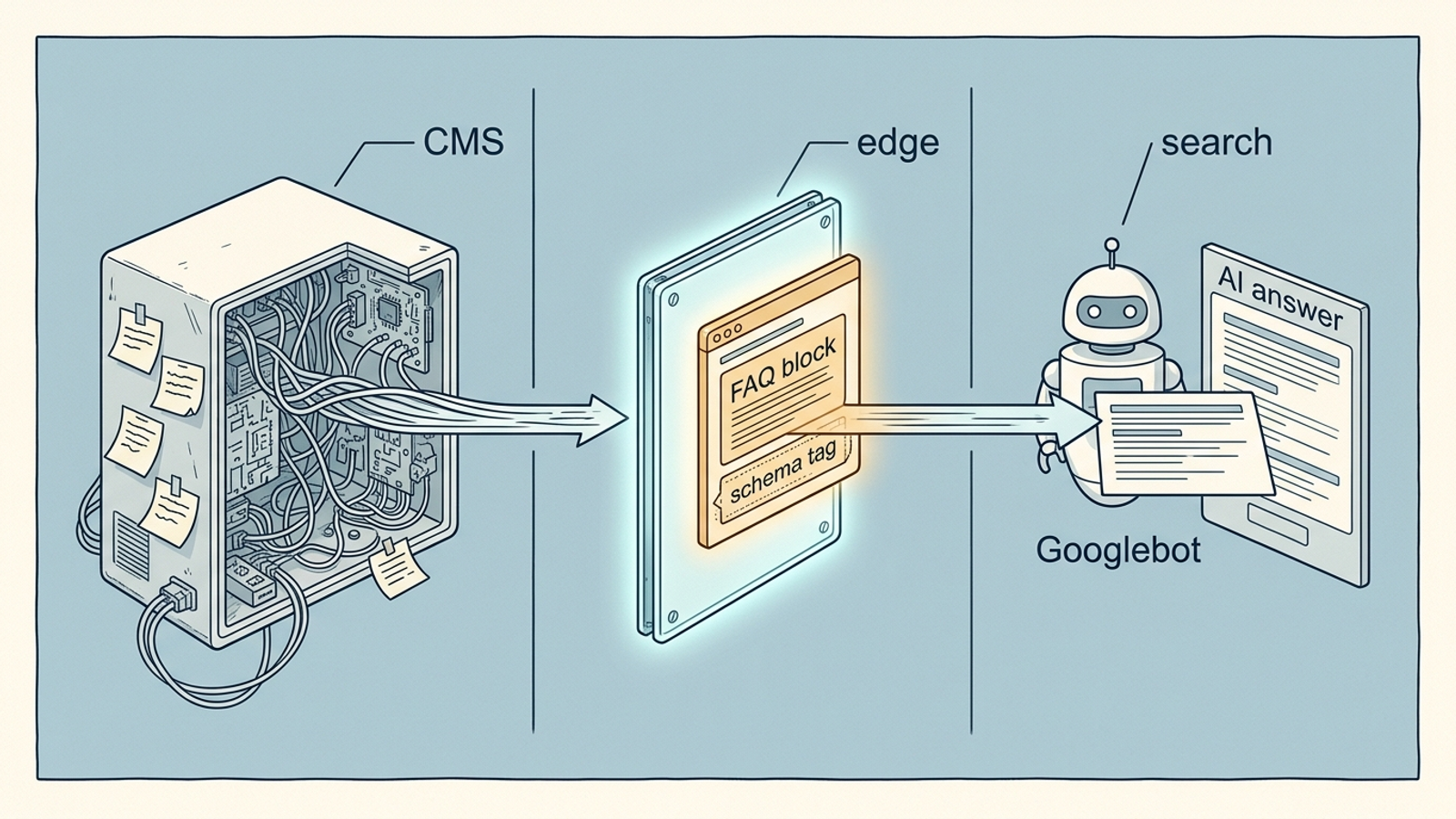
The first time I saw a way around that queue, it did not look like SEO at all. A DNS change, one approval from the client, and a worker sitting at the edge between their server and the rest of the internet. The origin CMS stays as it is. Dave still gets his second Thursdays. But after the CMS renders the page and before a visitor or crawler sees it, the edge layer can change what matters: the title, the meta, the canonical, the JSON-LD block, the FAQ structure, the redirect that has been sitting in Jira for six weeks.
That is the pattern edge-SEO shops describe: changes after the CMS renders HTML, without waiting for an origin release. Their breakdown of title, schema and redirect overrides reads like it was written by someone who had lived through the same dev queue I did. Instant deployment and rollback matter here not because they sound clever in a pitch, but because the agency can act while the page is still the problem. No sprint. No theme lock. No need to pretend a suggested fix is a shipped one.
That is also why I stopped laughing when the agency owner showed me the groas agency setup. There is one connection per client for ad accounts and website, designed to work across platforms and CMSs. Execution runs around the clock on bids and budgets on the paid side, and on content, technical fixes and citations on the organic side. Each action is logged with its reasoning. Reports go out under the agency’s brand; its team remains client-facing, with the strategist behind the work out of view.
I walked through how that afternoon onboarding works because I wanted to find the catch. As far as I can tell, the hard part is permission: the client has to let the system make changes to the site. That is not a footnote to the sale. It is the sale. If the client will approve monitoring but not publishing, the agency is back to carrying a PDF into Dave’s Thursday queue.
Think about the swapped headline on a Tuesday. With permission to execute, the system can restore the answer block and log what changed. If a plugin starts rendering the FAQ in JavaScript, a fix can ship from the edge instead of waiting for a theme developer. If citations slip, the agency can look at the changes and their reasons rather than trying to make a red arrow on a chart sound like progress. None of that means a client can never break a page. It means the agency has a route to fix the part it is being paid to manage.
I kept thinking about my 1am tab: the intact bids, the intact ad copy, the page that no longer matched either of them. I could see the damage before anyone else on the client’s team knew there was damage. Seeing it was not my problem. Having no way to act was.
Four questions before the logo goes on the report
I told him to ask every vendor the same four questions, in order. I wanted answers he could show a client, not a tour of the dashboard:
- Can you ship a title, a redirect and a schema block without my client’s developer?
- Can you show me the log where you did it last week, with the reason in plain English?
- When the client breaks a page on Tuesday, what happens before my Thursday report?
- Does the report go out under my name?
Most white-label pitches die on question one and wave their hands at question three. The order matters. A branded report is worth asking about only after you know the work behind it can reach the site. Otherwise, the agency gets the logo, the client gets the invoice, and the developer gets another ticket.
That is why I kept his groas trial instead of killing it. The agency plan runs SEO and AI search for a flat monthly fee per client domain, reported under your brand, and the first test runs on one live client before anything is paid. If you cannot touch the page, you are not selling AEO. You are selling hope with a logo.
At 1:14am, I had the change history open on one monitor and someone else’s landing page open on the other. He has ten domains in his rollout. I hope he asks the first question before one of those pages turns red.